
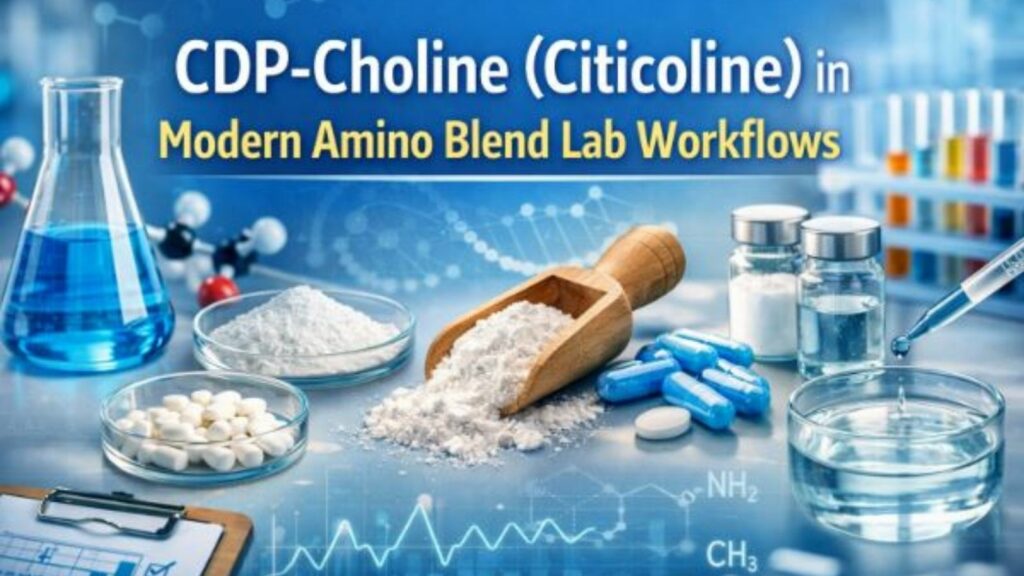
CDP-Choline (Citicoline): How Modern Amino Blends Support Brain and Energy Wellness
Researchers continue to explore how choline donors fit modern laboratory workflows. CDP-Choline (Citicoline) often sits at the center of that work. Labs value it for stability, mixing behavior, and clear analytical profiles. This article stays research-focused and avoids consumption claims. It explains how teams can structure an Amino Blend strategy around CDP-Choline. It also shows practical steps that improve consistency and data quality.
Why CDP-Choline Matters in Research Formulation
CDP-Choline (Citicoline) combines cytidine and choline in one compound. Researchers study Citicoline for its role in phospholipid pathway models. Teams also study how CDP-Choline behaves in solution. They measure solubility, pH drift, and stability over time. Those traits help when researchers build repeatable protocols.
Many labs compare choline sources during formulation work. CDP-Choline (Citicoline) often fits well in mixed systems. It typically disperses cleanly in common lab solvents. That behavior supports blend uniformity studies. It also supports controlled comparisons across batches.
Some labs use shorthand terms during internal documentation. You may also see the term Citicoline used in logs and labels. Keep naming consistent across SOPs. Consistency reduces confusion during audits.
How Citicoline Fits a Modern Amino Blend Strategy
Amino Blend projects aim to reduce experimental variability. They also aim to simplify handling steps. CDP-Choline can support that goal through predictable blending behavior. It can also support more consistent sampling. When you control inputs, you improve output data.
Researchers often pair CDP-Choline (Citicoline) with amino acids for pathway modeling. Amino acids can act as substrates in metabolic maps. They also help teams test compatibility across ingredient classes. Citicoline adds a choline-centered dimension to that matrix.
Use a structured approach when you add Choline. Start with the final objective of your experiment. Then work backward to select blend components. This method keeps your blend aligned with your hypothesis. It also reduces unnecessary complexity.
Practical Workflow: Sourcing and Verification for CDP-Choline
Step 1: Define your acceptance criteria
Write acceptance criteria before ordering CDP-Choline (Citicoline). Include purity targets, moisture limits, and particle size notes. Add acceptable solvent residues if relevant. This step reduces subjective decisions later.
Step 2: Require documentation and lot traceability
Request a COA for every lot of CDP-Choline. Confirm the lot number matches your container label. Store COAs in a shared repository. Link them to your inventory system.
Step 3: Run incoming verification tests
Plan quick checks for CDP-Choline upon receipt. Use methods that match your lab capabilities. Many teams use identity checks and moisture checks. They also check for visible clumping. Record results in a single template.
Step 4: Establish storage controls
Assign storage conditions based on your stability plan. Use desiccants when needed. Track temperature and humidity trends. Re-check Citicoline at defined intervals.
These steps create cleaner baselines. They also protect long-term projects from drift.
Practical Workflow: Building an Amino Blend with Citicoline
Step 1: Select compatible blend partners
Choose amino acids that match your research model. Document why each component belongs. Limit the number of variables when possible. Keep Citicoline as a clear, trackable driver ingredient.
Step 2: Choose a blending method that matches your scale
Small batches may use mortar blending or small tumblers. Larger batches may use V-blenders or ribbon mixers. Keep the method consistent across trials. Consistency improves cross-batch comparisons.
Step 3: Control order of addition
Order matters in powder blending. Add low-dose components with a carrier first. Then add mid-dose components. Add Citicoline at a defined stage and keep that stage fixed. This reduces segregation risk.
Step 4: Set mixing time and mixing speed targets
Define a minimum mixing time and speed range. Validate with sampling from multiple points. Use the same sampling map each batch. This practice strengthens reproducibility.
Step 5: Test blend uniformity
Use an assay marker to test uniformity. Many teams choose the most measurable component. CDP-Choline can serve as that marker when your method supports it. Record mean, variance, and acceptance limits.
This workflow helps researchers reduce waste. It also improves the quality of comparisons across experiments.
Stability, Handling, and Documentation Tips for CDP-Choline
Stability work often drives confidence in your data. Track CDP-Choline appearance, odor, and flow over time. Record clumping and color shifts. Add moisture checks when your environment fluctuates.
Create a one-page handling guide for CDP-Choline . Include PPE notes and spill steps. Include weigh-time limits to reduce exposure. Add re-sealing rules to prevent moisture uptake.
Documentation often decides whether results hold up. Use a standardized batch record for every Amino Blend. Include operator, date, equipment ID, and calibration status. Include blending sequence and mixing time. Add a section for deviations and corrective actions.
Mid-Protocol Pairing: Energy-Oriented Blend Concepts
Many labs examine transport and metabolism models alongside choline pathways. In those designs, CDP-Choline becomes one part of a broader matrix. Researchers often test compatibility with carnitine-related ingredients. They track dispersion, pH, and assay interference.
When your concept needs a transport-focused component, document the pairing logic clearly. Some teams explore a Carnitine Amino Blend concept within controlled research protocols. Keep component roles distinct in your notes. That clarity makes later interpretation easier.
Use a staged approach for pairings. First test each ingredient alone. Then test two-part blends. Finally test full Amino Blend batches with CDP-Choline (Citicoline). This approach reduces troubleshooting time. It also isolates interaction effects.
Actionable Quality Controls That Improve Research Outcomes
Use a simple risk register
List key risks for CDP-Choline blends. Include moisture, segregation, and assay overlap. Assign each risk a mitigation step. Review the register after every batch.
Build a sampling plan you can repeat
Sampling errors ruin blend studies. Create a fixed sampling map. Use the same container geometry each time. Sample from top, middle, and bottom zones. Log every sample location.
Validate your analytical method for your matrix
Method issues often look like formulation issues. Validate your method in the full Amino Blend matrix. Test recovery at multiple concentrations. Confirm linearity and repeatability.
Track time-on-bench for sensitive steps
Some labs see drift from ambient exposure. Track time-on-bench for CDP-Choline. Track it for the full Amino Blend too. Tight control reduces random variation.
These steps improve data reliability. They also make your reports easier to defend.
Common Pitfalls and How to Avoid Them
Pitfall 1: Too many variables at once
Large blends create complex noise. Start with fewer ingredients. Add CDP-Choline early in development. Expand later when the base system stabilizes.
Pitfall 2: Poor dose distribution in powder mixes
Low-dose ingredients can segregate easily. Use a carrier pre-blend. Then integrate the pre-blend into the full batch. Keep mixing parameters locked.
Pitfall 3: Inconsistent labeling and naming
Small naming differences cause big confusion. Use the same name everywhere. Use CDP-Choline on labels, logs, and methods. Avoid informal abbreviations in final records.
Pitfall 4: Weak change control
Changes happen during development. Log every change and the reason. Record the expected impact and the observed impact. This habit protects project integrity.
How to Turn Citicoline Blend Work Into Better Decisions
A structured workflow produces stronger learning. Citicoline becomes more useful when you track it well. Focus on repeatable steps and clean documentation. Use stability checks to confirm your assumptions. Use uniformity tests to validate your process.
When you apply these practices, you reduce reruns. You also reduce questionable results. You gain clearer signals from your data. That clarity helps you decide what to test next.
Further Reading and Internal Resources
If you want more research-focused compound notes and lab workflow resources, visit dillisatta.com research resources. Keep your sourcing, testing, and documentation aligned with your lab standards. Maintain research-only handling at every step.
Conclusion
CDP-Choline (Citicoline) supports structured research workflows through predictable handling and blend behavior. A disciplined Amino Blend process improves consistency, traceability, and data confidence. Use clear acceptance criteria, controlled blending steps, and repeatable sampling plans. Keep Citicoline documentation consistent across every batch and study.